Champagne Dough Workshop — Module 02: Rolling, Stretching & Knife Geometry Uniform Thickness Without Heavy Countertop Machines
Module 02 · Sheet & Strand Architecture

Rolling and Cutting with Control

When you flatten a rested ball of dough, you are not merely squashing it thinner—you are aligning gluten sheets so the cooked noodle has directional snap and uniform cooking speed from edge to center. If the middle of your sheet stays 2 mm thick while the edges taper to 0.5 mm, the edges will overcook and fray before the center loses its raw flour heart.

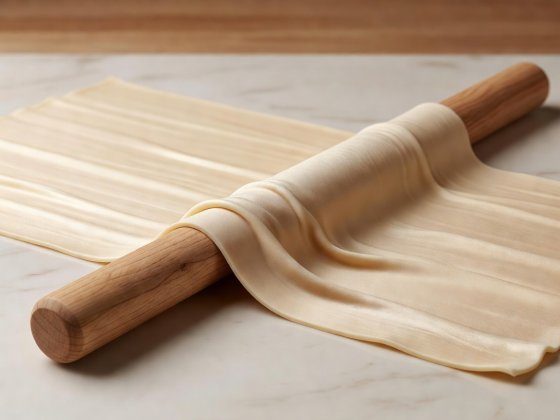
Soft-lit 3D render of a wide champagne-colored noodle sheet partially wrapped around a long wooden rolling dowel
Pin Technique

The Wrap-and-Slide Motion (Bo-Noshi & Mattarello)

Both Japanese soba/udon makers and Italian sfogline rely on a long cylindrical dowel (65 cm to 90 cm) rather than a short American baker's pin with rotating handles. Wrapping the dough around the pin turns the dough itself into its own thickness gauge.

Phase 1 · Disk Flattening

Center-Out Clockwise Passes

Press your rested dough sphere into a flat puck with your palm. Roll from the exact center forward to 12 o'clock, rotate the disk 30 degrees, and repeat until it reaches 22 cm across.

Phase 2 · The Pin Wrap

Lifting the Near Edge

Dust the top lightly with starch. Lay the dowel across the bottom edge and curl the dough tightly over the wood until two-thirds of the sheet is coiled around the bar.

Phase 3 · Outward Sweep

Heels of the Palms

Place both hands near the center of the wrapped pin. Roll forward three times while sliding your hands outward toward the ends of the dowel, applying gentle downward and outward traction.

Phase 4 · 90-Degree Turn

Even Biaxial Stretch

Unroll the sheet, rotate it 90 degrees on the board, dust any damp spots, and wrap again. Rotating prevents oval distortion and keeps thickness within 0.1 mm across the sheet.

Compounding Low-Hydration Sheets (Lamination for Snap)

When working with 35% hydration ramen or stiff udon dough, rolling once isn't enough. After rolling your sheet to 3 mm thickness, fold it in thirds like a business letter, press out trapped air with the pin, and roll it back out in the same direction. Passing the dough through two or three fold-and-roll cycles weaves individual gluten networks into a tight, laminated web that gives restaurant-grade noodles their unmistakable toothsome bounce.

Crucial rule: After compounding twice, rest the sheet flat under plastic for 20 minutes before final thinning, or the sheet will fight back.
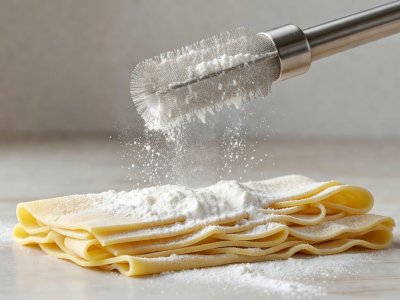
Soft-lit 3D render of a fine mesh duster sprinkling potato starch over folded noodle layers

Why Starch Beats Raw Flour at the Cutting Board

Raw wheat flour absorbs surface moisture from fresh noodles within minutes, bonding cut strands back together into a brick. Potato starch, tapioca starch, or coarse semolina act like microscopic ball bearings that stay dry until they hit boiling water.

Cutting & Pulling

Three Ways to Turn a Sheet into Strands

Match your cutting or pulling method to the viscosity of your target sauce or broth.

1. Accordion Pleat & Vertical Chop

Ideal for egg tagliatelle, kal-guksu, and homemade ramen. Let the rolled sheet air-dry on the board for 4 to 6 minutes until the surface feels cool and leathery rather than clammy. Dust both sides, fold into loose 6 cm pleats, and guide a flat-bellied nakiri or chef's knife straight down using your curled knuckles as a fence. Shake the ribbons open immediately and toss into loose nests.

2. Oiled Slab Slap-and-Pull (Shaanxi Belts)

Divide rested 48%-hydration wheat dough into 35 g logs, brush with neutral oil, and rest 45 minutes. Flatten a log into a 15 cm ribbon, press a chopstick lengthwise down the center to form a thin seam, then hold both ends and bounce the ribbon rhythmically against the table. The dough elongates to 80 cm in four bounces; tear along the center chopstick seam for two wide belts.

3. Hand-Torn Thumb Patches (Mian Pian & Maltagliati)

When making rich lamb stews, tomato-braised broths, or rustic bean soups, skip the knife entirely. Flatten oiled dough strips between wet fingers and flick thumb-sized patches directly into simmering broth. Each patch has a thick center for chew and feathered translucent edges that drink up soup.