Sauces, Bowls and Final Details
Even a beautifully kneaded, hand-cut noodle falls flat if the sauce pools at the bottom of a cold plate while the strands dry out on top. Connecting sauce to dough requires understanding surface roughness, starch-fat emulsification, bowl pre-warming, and how noodle geometry traps liquid.
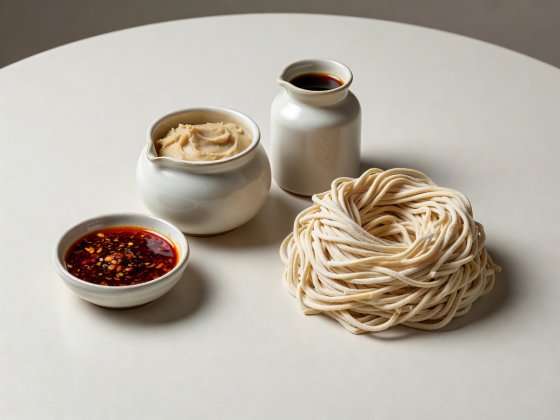
Four Asian-Inspired & Italian Sauce Architectures
Each sauce relies on a distinct binding mechanism—infused oil, roasted seed paste, fermented bean starch, or emulsified dairy fat—paired with the specific noodle cut that holds it best.
Shanghai Cong You Ban Mian
Best Noodle: Thin 1.4 mm alkaline or high-protein wheat strands
Technique: Slice 200 g of green scallion tops and white roots lengthwise. Submerge in 120 ml neutral peanut or rapeseed oil over medium-low heat for 22 minutes until the scallions turn deep mahogany and crisp without burning. Remove the crisps for garnish, then simmer dark soy sauce, light soy sauce, and rock sugar directly in the aromatic oil until syrupy. Toss with drained hot noodles so the caramelized soy-oil emulsion coats every thin strand.
Shaanxi Youpo Mian (Hot-Oil Belt Noodles)
Best Noodle: Hand-pulled 35 mm wide oiled wheat belts with thin ruffled edges
Technique: Warm the serving bowl with boiling water first. Season the bottom of the bowl with Chinkiang black rice vinegar, light soy sauce, and a pinch of salt. Lay hot boiled belt noodles on top with blanched bok choy. Crown the center with finely minced raw garlic, sliced scallion greens, toasted ground cumin, and coarse chili flakes. Pour 3 tablespoons of smoking-hot (205°C) oil directly over the garlic-chili pile; the instant sizzle cooks the raw garlic edges while releasing lipid-soluble capsaicin and volatile aromas.
Sichuan Dan Dan Mian (Dry-Tossed Style)
Best Noodle: Medium-thin round wheat or alkaline noodles (1.5 mm)
Technique: Combine Chinese roasted sesame paste (not raw tahini), sweet aromatic soy sauce (fuzhi jiangyou), red chili oil with sediment, ground roasted Sichuan花椒 (huajiao), and a splash of warm noodle cooking water in the bottom of the bowl. Top with hot noodles, crisp pork or shiitake ragù, and preserved Yibin芽菜 (ya cai) mustard greens. The diner stirs from the bottom up to coat the strands.
Mantecatura for Fresh Egg Tagliatelle & Tonnarelli
Best Noodle: Wooden-pin rolled egg pasta or square-cut guitar strings
Technique: Never grate Parmigiano-Reggiano or Pecorino Romano over boiling-hot dry noodles—casein proteins clump into rubbery strings above 68°C unless buffered by starch water. Whisk finely grated cheese with a splash of 55°C starchy pasta water into a smooth paste off the heat, then fold into the skillet while tossing rapidly to trap micro-bubbles of air and fat.
Presentation Details That Keep Noodles Lively to the Last Bite
Great presentation is thermal and structural engineering, not decorative clutter.
1. Pre-Warming Ceramic Bowls
Fresh noodles have high surface area and lose heat in seconds. Pouring hot noodles into a room-temperature ceramic bowl drops sauce temperature by 12°C instantly, causing butter or sesame paste to seize. Fill your serving bowls with ladlefuls of hot pasta-pot water while the noodles boil, then dump and wipe dry right before plating.
2. The Ramen Fold (Men-Tatami)
In soup bowls, never leave noodles in a tangled heap. Pour hot broth into the tare first, slide drained noodles in, then use long chopsticks to lift the entire bundle 15 cm out of the soup and fold it back over itself neatly like combed hair. This aligns the strands for easy lifting and forms a buoyant platform that keeps chashu, ajitama egg, and nori above the waterline.
3. The Carving Fork & Ladle Nest
For dry-tossed sauces and Italian ribbons, grip a single portion with a long two-prong carving fork, press the tines into the curve of a deep soup ladle, and twirl clockwise while lifting vertically. Slide the tight cylinder onto the center of the bowl so steam stays trapped inside the spire.