Champagne Dough Workshop — Module 01: Flour, Hydration & Gluten Feel Tactile Benchmarks for Wheat, Egg & Alkaline Doughs
Module 01 · Foundation

Dough You Can Read by Touch

Two bags of flour labeled with the exact same protein percentage can absorb water at completely different speeds depending on kernel hardness, starch damage during milling, and ambient kitchen humidity. When you train your fingertips to recognize hydration stages, you never have to guess whether to add another teaspoon of water or give the dough another twenty minutes of rest.

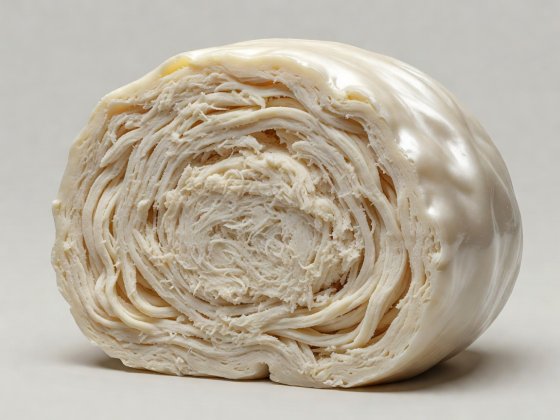
Soft-lit 3D render of a sliced noodle dough ball showing the transition from shaggy dry core to hydrated satin exterior
Grain Mechanics

How Flour Ash, Protein, and Liquid Interact

Wheat flour contains two primary storage proteins: gliadin, which gives dough viscosity and the ability to stretch without snapping, and glutenin, which provides elasticity and bounce. The liquid you introduce dictates how tightly those two proteins cross-link.

1. Pure Water & Sea Salt (Udon & Knife-Cut Wheat)

Dissolving 2% to 4% sea salt into water before mixing tightens the gluten matrix by shielding electrical charges on protein strands, allowing them to pack closer together. In Sanuki udon from Kagawa Prefecture, saline levels climb up to 12% in summer, creating a firm, leathery dough that can only be flattened by treading on it inside thick vinyl sheets.

Hand feel: Cool, dense, and slightly rubbery before resting; turns remarkably supple and glossy after a 2-hour rest.
2. Whole Egg & Yolk Emulsions (Sfoglia & Tagliolini)

In northern Italian pasta, water arrives bound inside egg albumen while lecithin and cholesterol-rich fats from the yolk coat flour granules. Because fat waterproofs part of the protein, gluten development stays delicate. Milling specifications matter here: finely pulverized Italian Tipo 00 soft wheat (ash content under 0.55%) hydrates evenly without dark bran specks that puncture thin sheets.

Hand feel: Warm, pliable like modeling clay, leaving zero wet residue on clean wooden boards.

3. Alkaline Salts / Kansui (Lamen & Lanzhou Inspiration)

Adding 1% sodium and potassium carbonate raises dough pH above 9.0. Flavonoid pigments naturally present in wheat turn pale yellow, and thiol-disulfide exchange tightens the protein network so fiercely that the dough resists stretching. Because hydration stays low (33%–38%), you never knead ramen dough into a smooth ball at first—you press hydrated crumbs into a flat slab.

Hand feel: Dry, pebble-like flakes that lock together only under firm vertical palm or foot compression.

Reference Benchmarks

Four Core Dough Profiles & Tactile Cues

Use these baseline ratios for a 300 g flour batch (enough for three generous bowls), adjusting water by 1–2 teaspoons according to the Pinched Oat Test described below.

Dough Tradition Flour Specification Hydration & Additives Initial Crumb Feel Rested Target Feel
Emilia-Romagna Egg Sfoglia 240 g Tipo 00 + 60 g Fine Semolina Rimacinata 3 whole medium eggs (~155 g, ~51.5% hydration) Silky paste inside flour well; gathers into tacky golden mass Smooth satin skin; holds finger dimple with minimal rebound
Shaanxi Hand-Pulled Belt (Biangbiang) 300 g All-Purpose / Bread Flour (11.2% protein) 144 g room-temp water (48%) + 4.5 g fine salt (1.5%) Soft, slightly tacky; comes together into a unified ball in 3 minutes Extremely extensible; stretches to 3x length when coated in oil
Northern Knife-Cut (Dao Xiao Mian) 300 g High-Protein Bread Flour (12.5% protein) 123 g cold water (41%) + 3 g salt (1%) Stiff, layered ridges; requires heel-of-hand folding to consolidate Firm like cheddar block; shaves cleanly into thin willow-leaf strips
Tokyo-Style Alkaline Ramen 297 g Bread Flour + 3 g Vital Wheat Gluten 108 g water (36%) + 3 g baked soda + 3 g salt Loose gravel and sand; no sticky cohesion when lightly squeezed Compacts under pin into dense, leathery amber sheet with zero air pockets
Hands-On Diagnostics

Step-by-Step Mixing & Touch Corrections

Follow the Water-Toss method to distribute moisture evenly before a single clump of glue can form at the bottom of your bowl.

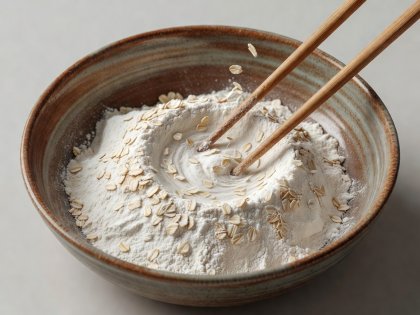
Soft-lit 3D render of wooden chopsticks stirring water into flour inside a deep ceramic bowl, forming uniform oat-sized flakes

1. The Chopstick or Fork Flake Method

Never dump all your water into the center of a dry bowl at once. Drizzle one-third of the liquid around the perimeter while sweeping chopsticks or curved fingers rapidly through the flour. You want thousands of tiny hydrated beads—each coated in dry flour—rather than one soggy core surrounded by dust.

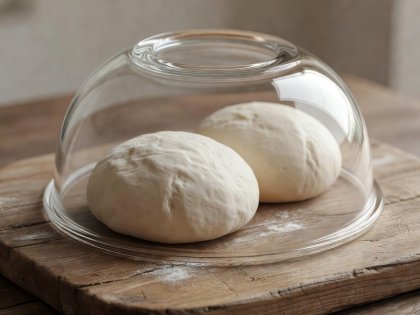
Soft-lit 3D render of two dough balls resting under an inverted glass bowl on a wooden pastry board

2. The Two-Stage Rest Protocol

Kneading a stiff noodle dough for 15 minutes straight tears gluten strands and oxidizes carotenoid flavours. Instead, knead for 3 minutes until rough, seal tightly for 25 minutes, then knead for just 90 seconds. You will feel the rough, bumpy ball transform into a glass-smooth sphere almost effortlessly.