Champagne Dough Workshop — Module 03: Boiling Dynamics & Texture Control Al Dente vs. QQ Bounce: Managing Starch & Heat
Module 03 · Pot & Basket Precision

Cooking Noodles to the Right Bite

Inside a pot of boiling water, two competing chemical reactions race against each other: wheat proteins coagulate into a firm structural scaffold between 65°C and 80°C, while starch granules absorb water, swell, and burst between 60°C and 95°C. Pulling your noodles at the exact intersection of those curves is what separates a lively, springy bowl from soft mush.

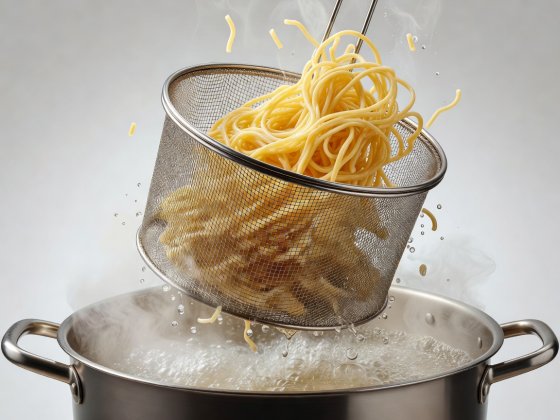
Soft-lit 3D render of a deep cylindrical mesh noodle basket lifting glistening golden strands above a boiling pot
Two Texture Ideals

Why "Al Dente" and "QQ / Koshi" Are Not the Same Thing

Cooks often use a single word for doneness, yet Italian dried durum pasta, fresh Bologna egg sfoglia, Taiwanese QQ wheat noodles, and Japanese udon aim for completely different physical cross-sections.

1. Italian Fresh Egg Pasta: Tender Coagulation

Unlike dried semolina rigatoni—which preserves a crisp unhydrated white core (the classic anima)—fresh egg tagliatelle is already hydrated throughout. Its structure comes from whole egg proteins setting rapidly in boiling salted water. Done properly, it has zero chalky core; instead, it offers a unified, springy bite that finishes hydrating inside the sauce skillet during the last 30 seconds of tossing.

2. East Asian "QQ" & Japanese "Koshi": Elastic Rebound

In Chinese, Taiwanese, and Japanese noodle craft, the prized texture is a smooth, slippery exterior paired with a deeply elastic, bouncy interior that pushes back gently against your molars. This comes from salted or alkaline gluten networks developed during kneading and resting, often locked in place after boiling by an energetic cold-water rinse that washes away surface slime and contracts swollen starch.

The Salting Rule: Salt the Dough OR the Pot

Never salt boiling water out of habit. Italian egg dough contains no salt inside the flour, so the cooking water must be salted at 1% (10 g per liter) to season the strands. Conversely, udon and alkaline ramen doughs already contain 2% to 10% internal salt; boiling them in salted water slows outward salt diffusion and leaves them overly briny.

Thermal Benchmarks

Detailed Cooking Times & Post-Boil Handling

Use at least 4 liters of water per 300 g of fresh noodles so the pot rebounds to a rolling boil within 20 seconds of immersion.

Noodle Type Thickness Boiling Time Post-Boil Protocol Why This Step Matters
Thin Egg Tagliolini 0.8 mm x 2 mm 45 – 60 sec Lift with tongs straight into warm butter/broth skillet; add 2 tbsp pot water Preserves delicate surface starch needed to emulsify light sauces
Standard Egg Tagliatelle / Pappardelle 1.1 mm x 8–20 mm 90 – 130 sec Transfer 25 seconds early to simmering ragù or pan sauce; toss vigorously Allows pasta to absorb flavored liquid rather than plain pot water
Alkaline Soup Ramen (Thin Straight) 1.2 mm x 1.2 mm 55 – 80 sec Drain in deep wire basket; perform 5 sharp downward shakes (yu-giri) Alkaline starchy water ruins clear chicken/pork broth and dilutes tare
Tsukemen Dipping Noodles (Thick Alkaline) 2.5 mm x 2.5 mm 4.5 – 6 min Plunge into running cold water, scrub strands between palms, drain well Removes gelatinized surface starch so concentrated dipping broth clings cleanly
Knife-Cut Wheat / Biangbiang Belts 2.0 mm x 30 mm 2 – 3 min Lift with spider strainer, shake off excess water, place in warmed wide bowl Retains internal heat required to bloom raw garlic and spices under hot oil
Fresh Hand-Cut Udon 3.5 mm x 3.5 mm 9 – 12 min Simmer at controlled roll; scrub vigorously in ice bath; re-warm briefly if serving hot Cold shock tightens retrograded starch molecules for signature glossy chew
Sensory Testing

Three Real-Time Cues at the Stove

Cue 1 · First 15 Seconds

TheChopstick Swirl

Shake loose starch from your nests before dropping them in. Wait 5 seconds for surface proteins to set, then sweep long chopsticks gently through the pot to separate strands without tearing them.

Cue 2 · Buoyancy Shift

Why Floating Does Not Mean Done

Fresh noodles float as soon as microscopic steam bubbles expand inside the dough—often within 20 seconds. Floating only marks the start of core gelatinization; thick noodles still need 1 to 8 minutes after rising.

Cue 3 · The Thumbnail Pinch

Checking the Cross-Section

Lift a single strand and pinch it in half with your thumbnail. Look at the severed end: an opaque powdery white stripe means raw starch remains; an even, translucent amber glow from edge to center signals peak readiness.